
The PeptideBible
A chronological, evidence-based history of how chemical messengers became readable, buildable, testable medicines—and why the living canon must keep changing when the evidence does.
First edition · Last reviewed September 14, 2026 · Independent clinical review: none to date
This page tells two stories side by side. The mythology is invented entertainment. The scientific record is factual, dated, and linked to sources.
Friday Gospel reports what is new. Only durable, verified milestones graduate into this chronology. Corrections are recorded; popularity never outranks evidence.
The chronology
Book 01
Before the Word
Before 1900

Medicine could observe effects before it could identify molecules.
For centuries, remedies and biological extracts were judged by visible outcomes. Some materials inevitably contained proteins or peptides, but practitioners could not isolate their components, determine amino-acid sequences, measure receptor activity, or run modern controlled trials. Penicillin belongs to this wider transformation of medicine, but it is an antibiotic—not the genesis of peptide science.
Book 02
In the Beginning
1902–1922

Chemical messengers became an experimental idea—and then a lifesaving therapy.
In London in 1902, William Bayliss and Ernest Starling reported that the intestine released a blood-borne signal, secretin, that stimulated pancreatic secretion. Starling introduced the term “hormone” in 1905. In Toronto in 1921, the insulin team isolated an extract with therapeutic potential; Leonard Thompson became the first person successfully treated in January 1922.
Book 03
The First Methods
1900s–1940s

Extraction made treatment possible, but purity was the central struggle.
Early hormone work relied on animal tissues, acid-alcohol extraction, precipitation, filtration, and repeated biological testing. The insulin story showed both the promise and the difficulty: the active material had to be separated from a complex organ extract well enough to help a patient without causing unacceptable reactions.
This era also carried practices and animal research that should be described honestly rather than romanticized. Modern standards for research ethics, manufacturing, identity, and purity did not arrive all at once.
Book 04
The Code Is Read
1950–1963

Sequence and synthesis turned biological substances into defined structures.
In the early 1950s, Vincent du Vigneaud’s group determined the structure of oxytocin and achieved its synthesis—the first synthesis of a peptide hormone. Frederick Sanger’s work established insulin’s amino-acid sequence, showing that a protein could have a precise chemical order. In 1963, R. Bruce Merrifield published solid-phase peptide synthesis, anchoring a growing chain to a solid support so repeated chemical steps could be performed more efficiently.
Book 05
The Original Six
1930s–1969
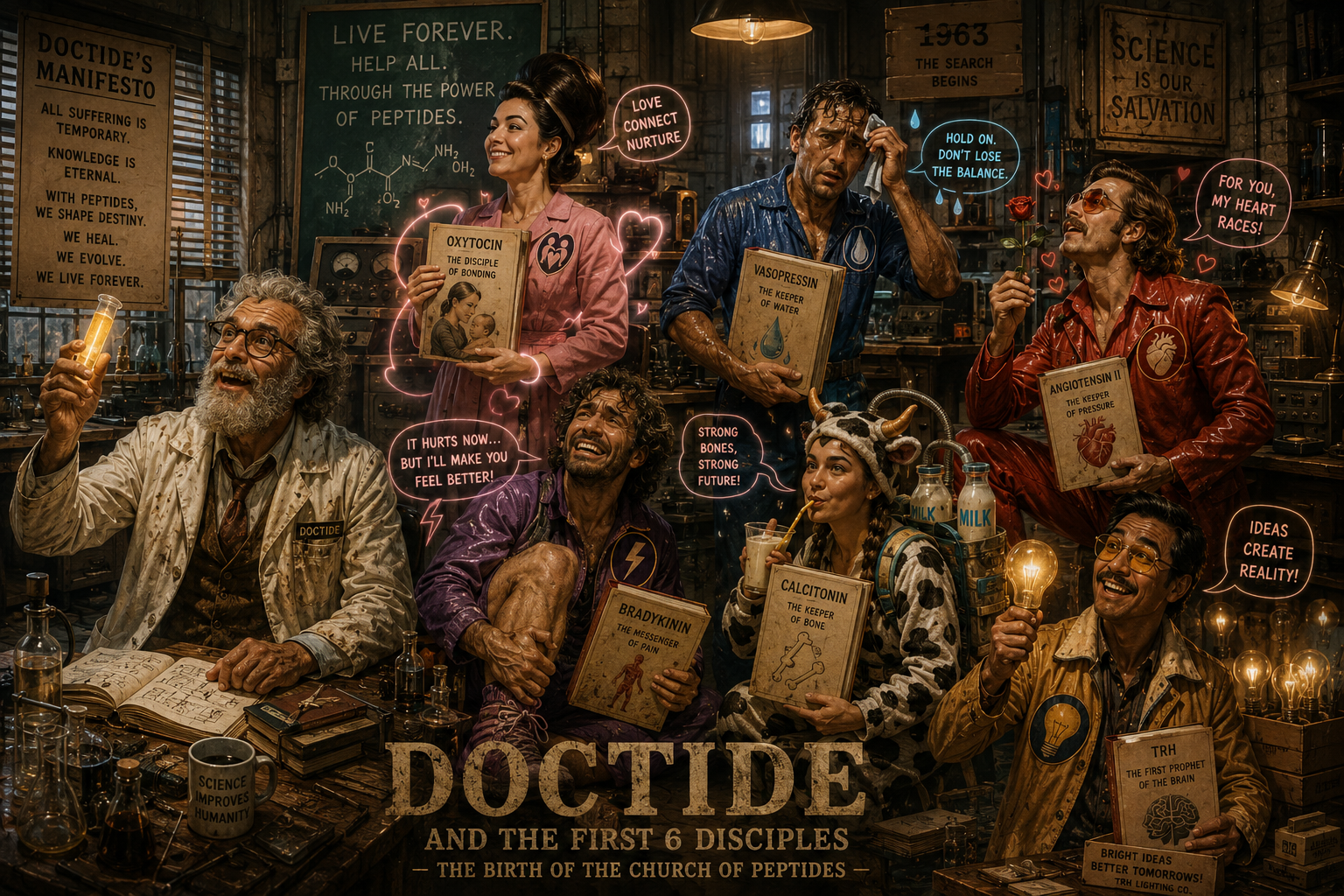
The six are fictional characters built around real scientific milestones.
Oxytocin, vasopressin, bradykinin, angiotensin II, calcitonin, and thyrotropin-releasing hormone entered science through different laboratories, countries, and decades. The Church groups them as the Original Six because together they introduce core themes in peptide signaling: reproduction and bonding, water balance, pain and vascular signaling, blood pressure, calcium regulation, and endocrine control.
The grouping is editorial mythology, not a scientific category. TRH also appears among the Prophets because determination of the first hypothalamic releasing-hormone structure helped establish neuroendocrinology; dual membership is allowed only when a molecule has a distinct, well-sourced role in each order.
Book 06
Why the Movement Began
The editorial origin

The Church exists because peptide information is unusually easy to oversell.
Approved peptide medicines, controlled human research, observational reports, animal studies, laboratory mechanisms, commercial blends, and unsupported claims often appear in the same online conversation. The Church of Peptides uses memorable fiction to draw readers in, then separates those categories explicitly.
Doctide is a fictional founder and editorial device—not a physician, historical scientist, or medical authority. The site currently has no independent clinical reviewer.
Book 07
Trials, Triumphs and Setbacks
Evidence in humans

A biological mechanism is only the beginning of a human claim.
Clinical development asks progressively different questions: early studies characterize human safety and behavior; later controlled trials test efficacy and harms in the intended population; post-approval monitoring continues after wider use. Programs may stop because of toxicity, weak efficacy, impractical delivery, manufacturing problems, or commercial decisions. A failed trial does not make every mechanism false, and an exciting mechanism does not establish clinical benefit.
Book 08
The Evolution
1982 onward

Peptide development moved from extraction toward recombinant production and deliberate molecular engineering.
FDA approval of recombinant human insulin, Humulin, in 1982 marked a biotechnology turning point. Across later decades, developers used sequence substitutions, fatty-acid attachment, cyclization, depot formulations, and other strategies to alter stability, receptor preference, exposure, or delivery. These changes can create useful medicines, but each engineered molecule still requires its own evidence.
Book 09
The Control
Regulation & oversight

Different authorities answer different questions.
FDA regulates medicines in the United States; EMA coordinates scientific evaluation and safety monitoring within the European Union system; WADA sets anti-doping rules for sport. Approval in one jurisdiction is not universal approval. A clinical-trial listing is not approval. WADA prohibition is not a judgment that a medicine never has a legitimate clinical use.
The “Imperial Bureau” is satire. Real regulators evaluate evidence, manufacturing quality, labeling, safety signals, and compliance within distinct legal systems.
Book 10
The Economy of the Canon
From molecule to market

A peptide product sits inside an ecosystem, not a single ticker.
Developers and license holders depend on active-ingredient production, contract development and manufacturing, synthesis equipment and reagents, fill-finish capacity, analytical testing, packaging, cold-chain logistics, pharmacies, health systems, insurers, and regulators. Commercial exposure can be direct or indirect, and company disclosures do not prove clinical value.
The weekly Market Tithe distinguishes confirmed filings and reported sales from editorial inference. It does not rank sellers, identify sources for unapproved products, or provide investment recommendations.
Book 11
Modern Times
A crowded field

Modern peptide medicines span far more than one trend.
Approved peptide and peptide-related medicines now address endocrine, metabolic, gastrointestinal, reproductive, oncologic, and other conditions. The current incretin era—represented on this site by GLP-1, liraglutide, semaglutide, tirzepatide, and investigational multi-receptor candidates—has increased public attention, investment, manufacturing pressure, and misinformation at the same time.
Approval status, indication, formulation, and evidence differ by molecule and jurisdiction. “Peptide” is a structural description, not a guarantee of benefit or safety.
Book 12
Safety Measures
Identity before promise

Safety starts before a product reaches a person.
Identity, potency, purity, sterility when required, stability, packaging, storage, traceability, and manufacturing controls all matter. So do contraindications, interactions, adverse-event monitoring, and whether a use has actually been studied in humans. A label such as “research use only” does not convert an unapproved human-use product into an evaluated medicine.
This publication does not provide dosing, sourcing, prescribing, purchasing instructions, or individualized treatment advice.
Book 13
The Living Canon
Now & next

The canon changes through documented evidence, not applause.
Epistide’s Friday Gospel tracks regulatory changes, human trial results, peer-reviewed science, safety signals, company disclosures, and market effects. The Scribe verifies candidates and uncertainty. Agent Better protects the Original Six and story continuity. The Herald keeps permanent pages discoverable. CHINCHIBOSS makes sure each role works from the currently published site.
New information may correct a record without changing a character’s order. Canon movement requires an explicit editorial judgment, a dated rationale, and a visible change—not a sponsor’s request.
“The canon is living.
The receipts are permanent.”
Educational entertainment only. Invented continuity is labeled in every chapter. Scientific records are summaries, not medical advice.
The Pilgrimage · From Molecule to Medicine
Follow one fictional peptide through discovery, trials, funding, approval and the realities of launch.
Explore the eight-chapter journey →History, development and the volunteer’s perspective
This Bible follows documented milestones. The Pilgrimage explains the development process through a fictional molecule, while the Book of Trials introduces a fictional volunteer’s perspective on research. Neither fictional story is part of the historical record above.