The founding myth · fictionA need beneath the noise
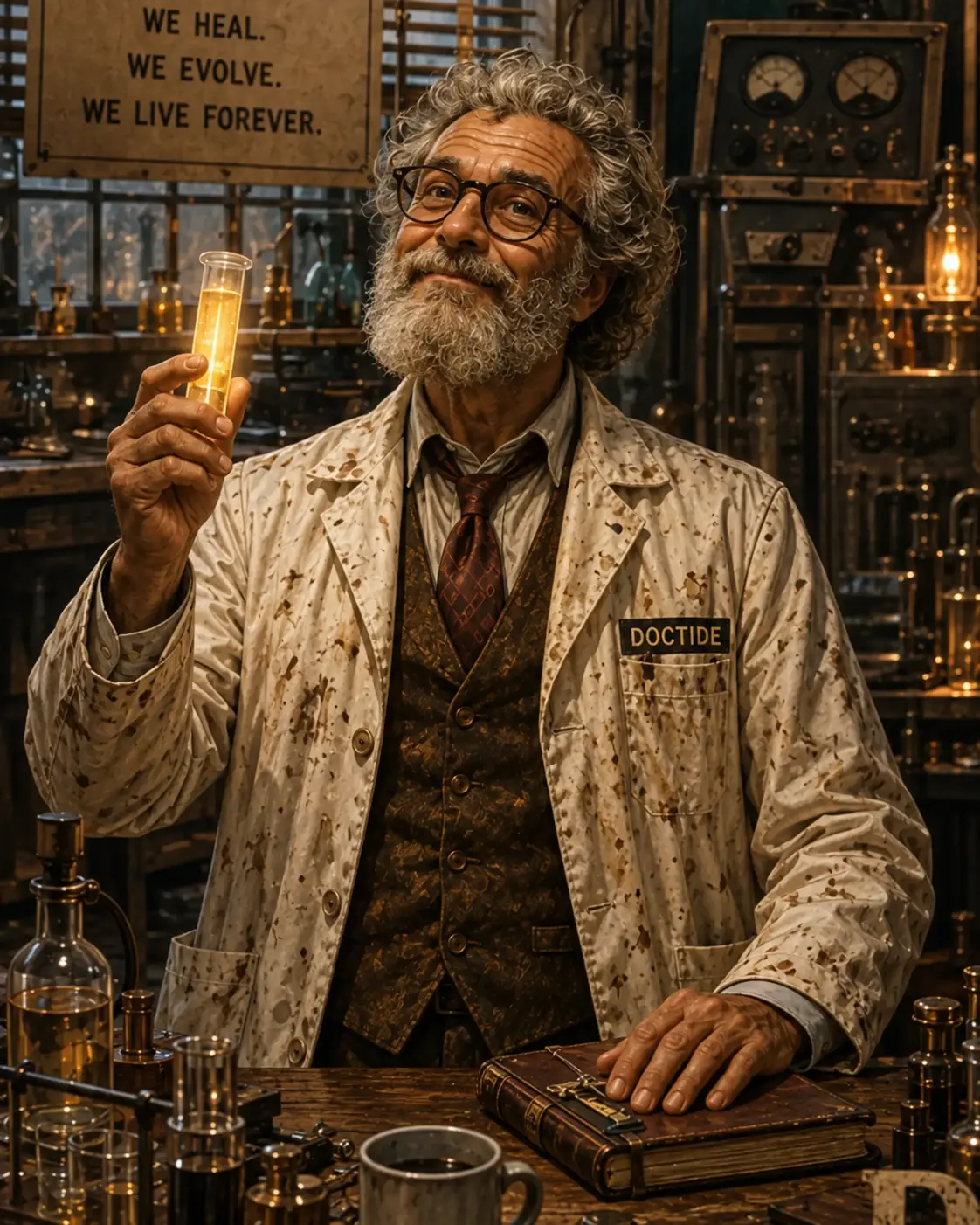
In 1963, Doctide looked at a medicine cabinet full of blunt instruments and imagined smaller messages: molecules that might speak the body’s own language instead of simply shouting over it. He opened a dirty laboratory, found six messengers already waiting, and wrote on the wall: “Faith inspires the search. Evidence determines the canon.”
The bold passage is invented continuity for the Church of Peptides.The real historical settingMedicine was changing shape
Doctide is fictional, but 1963 is not an arbitrary year. Modern peptide science was becoming technically possible at the same moment medicine was learning to manufacture biology with precision.
Before 1963Hormones become molecules
Insulin had transformed diabetes care after 1922. Oxytocin became the first peptide hormone synthesized in 1953. Researchers were proving that biological “messages” could be isolated, sequenced, and rebuilt.
1963Peptide synthesis becomes a platform
R. Bruce Merrifield reported solid-phase peptide synthesis, a method that made building peptide chains faster and more systematic. The work later received the 1984 Nobel Prize in Chemistry.
1970s–1980sFrom extraction to biotechnology
New assays revealed hormones present in tiny concentrations. Recombinant DNA then allowed human proteins to be produced in microorganisms; FDA approved recombinant human insulin in 1982.
1990s–2010sEngineering the message
Scientists modified natural peptide signals to last longer, bind differently, or reach practical clinical targets. Some became approved medicines; many candidates failed, stalled, or remained experimental.
2020sThe age of enormous promise—and enormous hype
GLP-1–based medicines changed metabolic care, while online markets began selling poorly characterized “research peptides” beside legitimate therapies. The need now is not blind enthusiasm or automatic rejection. It is classification, evidence, quality, and honest uncertainty.