
An illustrated learning journey
The Pilgrimage
From Molecule to Medicine
One idea. Years of testing. A great many invoices.
Follow COP-001 through eight chapters about what it takes to turn a promising molecule into an available medicine—and all the places that journey can end.
Open any chapter to read its story, evidence and ledger.
01Genesis
Finding a target

Fictional timeline · Years 0–1
FICTIONAL STORY. Doctide proposes COP-001, a peptide for recurrent salt-loss episodes in a completely invented inherited transport disorder. Mara, our fictional patient, asks for fewer disrupted days. Epistide asks whether the proposed target actually causes the problem. Neither question fits on the fundraising banner.
What really happens
Discovery starts with a biological question. Researchers investigate targets and candidate properties; an interesting mechanism is not proof of patient benefit. [1]
Who is involved
Patients and advocates, academic scientists, medicinal chemists and the founding team.
Profitide’s ledger
A fictional $1m grant funds the first experiments. All $1m is spent. Cash remaining: $0m.
The patient’s perspective
Define a meaningful improvement with patients before selecting a convenient laboratory measurement.
02The First Trials
Laboratory and preclinical testing
Fictional timeline · Years 1–3
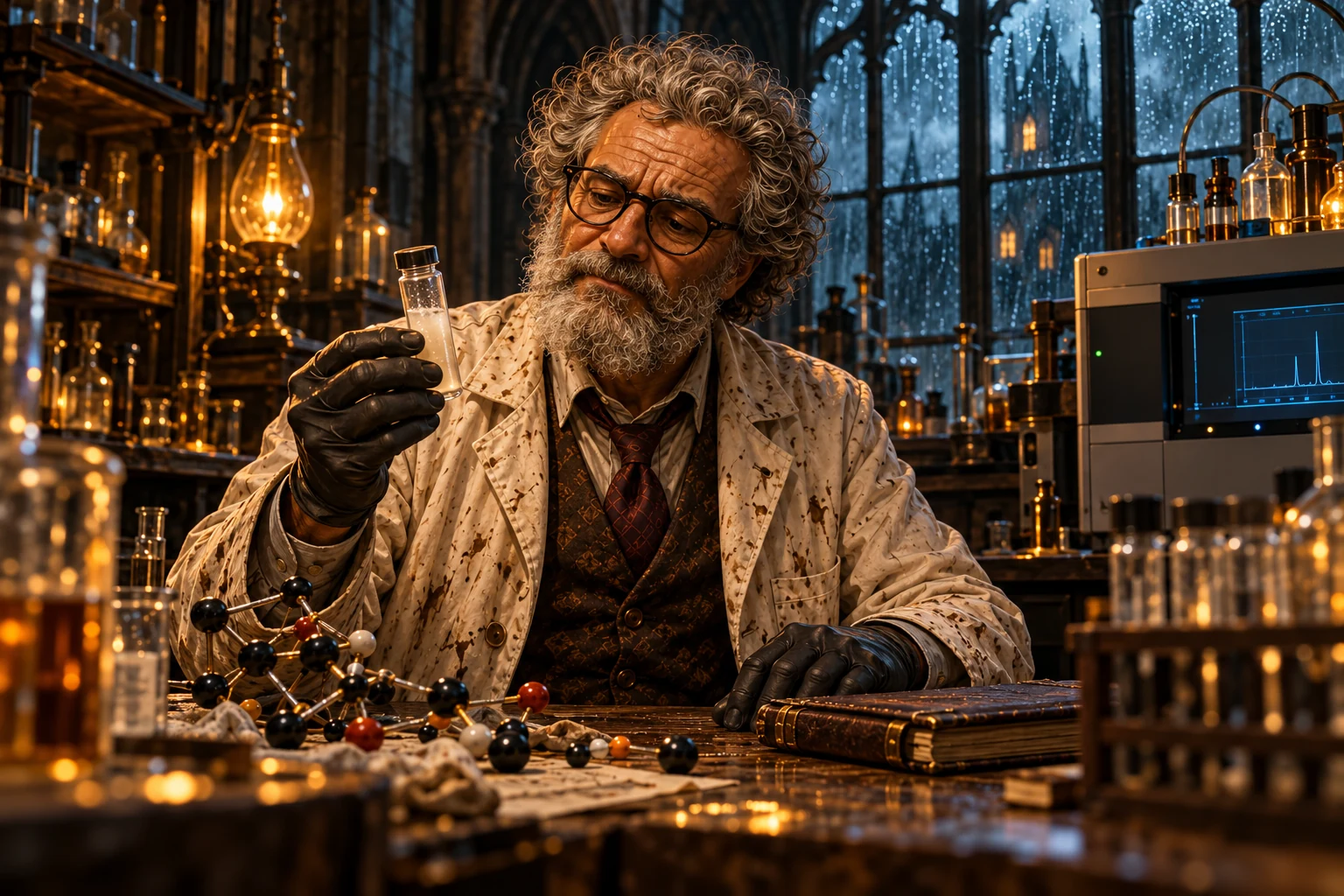
FICTIONAL STORY. COP-001 produces the hoped-for laboratory response, then falls apart in storage. A redesigned formulation lasts longer, but an animal finding raises a new question. Doctide puts the victory speech back in the drawer.
What really happens
Preclinical work includes laboratory and animal studies to investigate toxicity and other properties before human testing. These findings inform development; they cannot establish human efficacy. [2]
Who is involved
Pharmacologists, toxicologists, analytical scientists, formulation teams and research contractors.
Profitide’s ledger
Seed investors contribute $5m; the team spends $4m. Cash remaining: $1m.
The patient’s perspective
An experiment that stops an unsafe candidate is useful progress, even without a product.
03The Offering
Funding the next milestone

Fictional timeline · Years 2–4
FICTIONAL STORY. The corrected formulation earns another chance. Profitide secures a $20m Series A, then discovers that money has a remarkable talent for leaving. The team spends $8m preparing its next evidence package and human-study program.
What really happens
In this fictional financing, new investors receive 25% of the company after the round; existing holders retain 75%. Further rounds can dilute them again. Equity purchases ownership; it does not purchase a favorable scientific result. This is a simplified example, not a typical valuation or financing benchmark.
Who is involved
Founders, investors, grant administrators, legal counsel and development leaders.
Profitide’s ledger
Opening cash $1m + $20m financing − $8m spending = $13m. Fictional Profitide: “The offering plate has a burn rate.”
The patient’s perspective
Funding priorities can affect which questions are studied and whose needs are represented.
04The First Volunteers
Early human trials

Fictional timeline · Years 4–5
FICTIONAL STORY. After the fictional investigational application is allowed to proceed, volunteers enter an independently reviewed protocol. COP-001 behaves differently in people than the team expected. Enrollment pauses while a safety finding is investigated; a revised protocol permits the story to continue.
What really happens
Early clinical studies examine safety and how a drug behaves in people. In the U.S., an IND includes preclinical, manufacturing and proposed clinical information; FDA can place a clinical hold. Ethics review and informed consent are essential. Early safety observations do not establish effectiveness. [3]
Who is involved
Participants, investigators, study coordinators, ethics reviewers, regulators and safety specialists.
Profitide’s ledger
No new financing. $12m spent from $13m. Cash remaining: $1m.
The patient’s perspective
Participation is a choice under uncertainty, not a promise of benefit.
05The Trial of Faith
Testing whether it works

Fictional timeline · Years 5–7
FICTIONAL STORY. The first patient study misses its planned endpoint. A post-hoc subgroup looks tempting. Epistide refuses to rename failure a miracle. Investors fund a separate, prospectively specified controlled study; that study supports further testing, while adverse effects still need scrutiny.
What really happens
Controlled studies compare outcomes under a prespecified protocol. Phase 2 explores efficacy and safety in patients. Exploratory analyses can generate hypotheses; confirmatory evidence must be evaluated on its own design and results. [3]
Who is involved
Patients, clinicians, statisticians, trial sites, independent reviewers and the sponsor.
Profitide’s ledger
Series B brings $60m; studies and operations consume $40m. Opening $1m becomes $21m.
The patient’s perspective
Does the measured change improve daily life, and at what burden or risk?
06The Great Assembly
Confirmatory trials and manufacturing

Fictional timeline · Years 7–10
FICTIONAL STORY. A licensing partner arrives with a headline: “Up to $500 million.” Then one production batch fails specification. The confirmatory program continues while the team investigates, corrects the process and demonstrates that the medicine can be made consistently.
What really happens
Phase 3 studies further assess benefit and safety. Manufacturing quality is a separate requirement: clinical promise does not excuse inconsistent production. Development, quality work and trial preparation overlap rather than forming a perfectly straight line. [3] [4]
Who is involved
Trial networks, manufacturing partners, quality teams, supply specialists and the licensee.
Profitide’s ledger
The developer receives $100m upfront and an earned $40m development milestone; it spends $140m. Cash stays $21m. The hypothetical deal also includes $60m upon approval and $300m of conditional sales milestones. Those unpaid amounts are not cash.
The patient’s perspective
Reliable quality and a usable product matter alongside the trial result.
07Before the Bureau
Regulatory review

Fictional timeline · Years 10–11
FICTIONAL STORY. The fictional application returns with questions. After additional analysis and a manufacturing correction, COP-001 receives a fictional U.S. approval for a narrowly defined adult population. Doctide wants a parade. Epistide wants the label read aloud.
What really happens
FDA reviews the submitted evidence for the proposed use, alongside labeling and other application information. It may require answers or additional studies before approval. Approval concerns a defined use and population; it is not a declaration that a medicine is risk-free or suitable for everyone. [5]
Who is involved
Regulatory reviewers, the sponsor, statisticians, inspectors and labeling specialists.
Profitide’s ledger
The $60m approval milestone is now earned; $45m is spent. Cash increases from $21m to $36m. Of the headline $500m license deal, $200m has been received; $300m remains contingent.
The patient’s perspective
Clear benefits, risks and eligibility matter more than a celebratory headline.
08Beyond the Gates
Launch, access and ongoing safety

Fictional timeline · Years 11–12 and beyond
FICTIONAL STORY. Mara finally has an approved option in this invented world—but coverage takes time, and another patient cannot afford it. Supply improves. A newly reported adverse event triggers investigation. The launch succeeds commercially only if the medicine can reach appropriate patients and remain worth its risks.
What really happens
Safety monitoring continues after approval. Reports can reveal signals that need investigation; a reported event alone does not prove causation. Approval also does not guarantee affordability, coverage or commercial success. [6]
Who is involved
Patients, prescribers, pharmacists, payers, distribution teams, the licensee and safety regulators.
Profitide’s ledger
The developer spends $25m on remaining launch obligations, leaving $11m before commercial royalties. In a separate invented first-year licensee income statement: $80m net sales − $20m production − $25m selling/admin − $15m ongoing research/safety − $8m royalty = $12m operating profit, before interest and tax. Revenue is not profit. The developer’s $8m royalty is a different company’s receipt, excluded from the development ledger below.
The patient’s perspective
Access, practical burden, continued benefit and emerging risks determine the real-world value.
Keep the receipts
The fictional developer’s ledger
USD millions. One simplified developer cash account through launch; commercial sales belong to the licensee. This is a teaching scenario, not an estimate of the cost to develop a drug. It excludes taxes, interest and financing fees. Spending includes the developer’s contracted development and launch obligations; the licensee’s later commercial costs are separate.
| Chapter | Cash received | Spent | Cash left |
|---|---|---|---|
| 1 · Genesis | $1m | $1m | $0m |
| 2 · The First Trials | $5m | $4m | $1m |
| 3 · The Offering | $20m | $8m | $13m |
| 4 · The First Volunteers | $0m | $12m | $1m |
| 5 · The Trial of Faith | $60m | $40m | $21m |
| 6 · The Great Assembly | $140m | $140m | $21m |
| 7 · Before the Bureau | $60m | $45m | $36m |
| 8 · Beyond the Gates | $0m | $25m | $11m |
| Total / closing cash | $286m | $275m | $11m |
Fundraising is not sales. An unearned milestone is not cash. One year’s operating profit does not repay the entire historical development bill. A failed program may leave no product and no return.
What would count as success?
A meaningful benefit, acceptable risks, reliable quality and workable access—not approval or profit alone. A responsibly stopped program can also protect people. This story follows one successful branch while keeping the alternatives visible.
Read the real history → Meet Profitide’s market record →The factual record
Primary regulatory background; accessed September 29, 2026. The original AI-generated illustrations were created for The Pilgrimage. They depict fictional scenes, not photographs of clinical work. No source endorses COP-001. This is educational storytelling, not treatment or investment advice.